
Quantum in Orbit: An Introduction

Updated: Aug 28
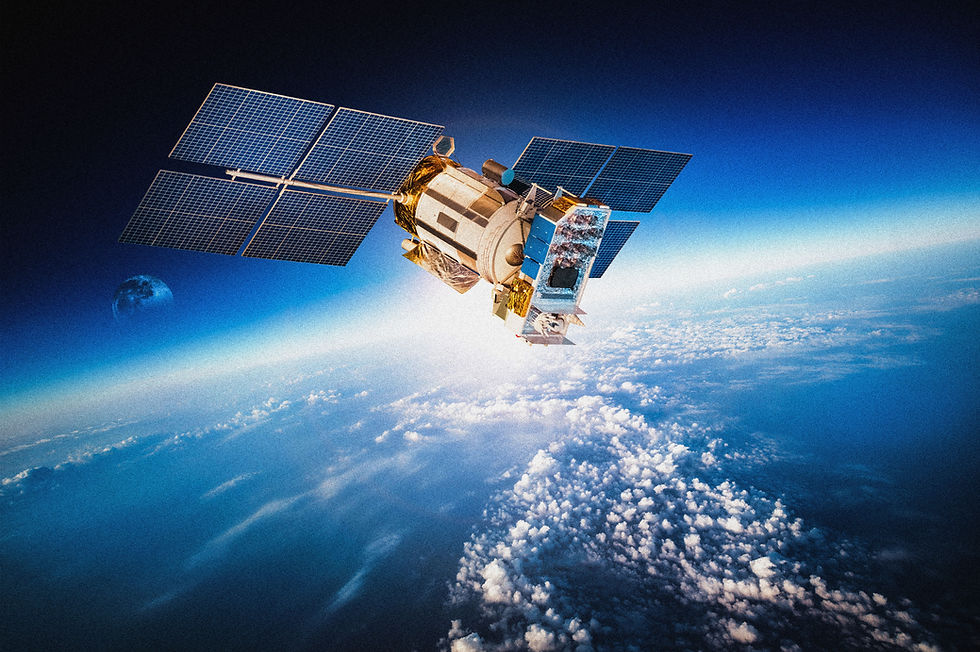
When we think about space technology, the first images that usually come to mind are rockets, satellites, astronauts, telescopes and enormous launch facilities. Yet an increasingly important part of the next generation of space infrastructure operates at a scale that we cannot see at all: individual photons, ultracold atoms and quantum states. Quantum technologies, once largely confined to highly controlled laboratory experiments, are gradually being adapted for operation in orbit, where they could support secure global communications, more precise measurements of the Earth, highly accurate timing systems and new approaches to navigation.
In other words, the next space race is not only about who can launch more satellites or travel farther. It is increasingly also about who can communicate, measure and navigate with quantum precision.
Why Put Quantum Technology in Space?
One of the main reasons for taking quantum technology into space is surprisingly straightforward: distance. Quantum communication typically relies on transmitting extremely weak optical signals, sometimes down to the level of individual photons. When these photons travel through a conventional optical fibre, some are inevitably absorbed or scattered, causing the number of successfully transmitted photons to decrease rapidly with distance. Classical telecommunications compensate for signal loss using amplifiers and repeaters, but quantum information cannot simply be copied and amplified in the same way because of the quantum no-cloning theorem.
Quantum repeaters could eventually help overcome this limitation by combining technologies such as quantum memories and entanglement swapping, but large-scale repeater networks remain technically challenging. Satellites provide another approach because most of a space-to-ground optical link passes through near-vacuum rather than thousands of kilometres of optical fibre. Photons still experience losses caused by diffraction, atmospheric turbulence, absorption and imperfect pointing, but the overall architecture makes satellite links particularly attractive for connecting quantum networks over continental and potentially global distances. A comprehensive overview of these advantages and the engineering challenges involved can be found in the Satellite Quantum Communications review by Sidhu et al.
Quantum Key Distribution: Securing the Keys
The most mature application of quantum technology in space is Quantum Key Distribution (QKD). QKD is sometimes described as “quantum encryption,” but this can create the misleading impression that the entire message itself is transmitted as quantum information. Instead, quantum states are generally used to establish a shared secret cryptographic key between two users. That key can then be used with conventional cryptographic systems to protect the actual information being exchanged.
The security principle originates from the behaviour of quantum systems during measurement. In protocols such as BB84, information is encoded into quantum states prepared using different measurement bases. An eavesdropper attempting to intercept and measure these states without knowing the correct basis can introduce detectable errors into the transmission. The legitimate users can estimate the error level and, if the conditions required by the protocol are satisfied, apply classical procedures such as error correction and privacy amplification to produce a final secret key. QKD, therefore, does not make an entire communication system automatically “unhackable”; rather, it provides a fundamentally different method of establishing cryptographic keys whose security can be based on quantum-mechanical principles.
This distinction is important because practical quantum networks will still contain conventional computers, authentication mechanisms, ground stations, satellites and network infrastructure. The quantum layer strengthens a particular part of that security architecture rather than eliminating every conventional cybersecurity risk.
Micius: Taking Quantum Communication into Orbit
The landmark demonstration of satellite quantum communication came with China's Micius satellite, also known as the Quantum Experiments at Space Scale mission. Launched in 2016, Micius carried specialised optical equipment designed to transmit quantum states between a satellite and optical ground stations. In 2017, researchers reported satellite-to-ground QKD over distances of up to approximately 1,200 kilometres, demonstrating that satellite links could extend quantum communication far beyond the practical range of direct fibre transmission.
Micius subsequently enabled experiments involving entanglement distribution and quantum teleportation. In one landmark experiment, researchers demonstrated ground-to-satellite quantum teleportation over distances reaching approximately 1,400 kilometres, showing that quantum states could be transferred between the ground and an orbiting satellite.
The programme later moved beyond individual experimental links. Researchers demonstrated entanglement-based QKD between ground stations separated by more than 1,100 kilometres, using the satellite to distribute entangled photons to geographically separated receivers. This represented an important step toward architectures in which quantum correlations can be distributed across extremely large distances.
By 2021, researchers had reported an integrated space-to-ground quantum communication network extending over 4,600 kilometres, combining satellite links with a large terrestrial fibre-QKD network. This represented an important shift in the field: the question was no longer simply whether quantum communication from space was possible, but how individual quantum links could eventually be connected into much larger communication infrastructures.
The Engineering Challenge Behind a Quantum Link
These demonstrations are scientifically impressive, but operating a quantum link from orbit is an enormous engineering challenge. A satellite in Low Earth Orbit moves relative to the Earth's surface at several kilometres per second, while an extremely narrow optical beam must remain aligned with a ground-based telescope. This requires highly precise acquisition, pointing and tracking systems capable of continuously compensating for the satellite's movement.
The atmosphere creates another challenge. Turbulence can distort the optical beam, atmospheric absorption reduces the number of photons reaching the receiver, and background light can introduce additional detector noise. Cloud cover can prevent an optical link altogether, while a Low Earth Orbit satellite may only remain visible from a particular ground station for a limited period during each pass. Building a global quantum communication system, therefore, requires considerably more than a quantum photon source: it requires optical ground stations, precision telescopes, highly sensitive detectors, stable lasers, accurate timing systems and sophisticated network management.
These practical limitations are one reason why satellite quantum communication is increasingly becoming an interdisciplinary field connecting quantum physics, photonics, aerospace engineering and telecommunications.
Quantum Sensors: Using Atoms to Observe the Earth
Communication is only one side of the emerging quantum-space landscape. Another major area is quantum sensing, particularly the development of cold-atom interferometers capable of measuring acceleration and gravity with extraordinary precision.
These instruments exploit the wave-like properties of matter predicted by quantum mechanics. Atoms such as rubidium can be cooled using lasers to temperatures extremely close to absolute zero, dramatically reducing their thermal motion. Carefully controlled laser pulses can then manipulate the atoms so that their quantum states effectively follow different paths before being recombined. Tiny changes in acceleration or gravity alter the relationship between these paths, allowing the instrument to detect extremely small variations in motion or gravitational acceleration.
Space is particularly attractive for this type of measurement because atoms can remain in free fall for longer periods under microgravity conditions. Longer observation times can increase the sensitivity of atom-interferometric measurements, which is one reason why cold-atom quantum sensors are being investigated for future space missions.
Measuring a Changing Planet
The ability to measure gravity extremely precisely has important consequences for Earth observation because the Earth's gravitational field reflects how mass is distributed across the planet. When groundwater reserves decline, glaciers lose ice, ocean masses shift or large hydrological systems change, the distribution of mass changes slightly and therefore produces tiny variations in the gravitational field.
Current satellite gravimetry missions already use gravitational measurements to study these processes. Future quantum accelerometers could potentially increase the sensitivity of such observations, providing scientists with new tools for studying groundwater, ice sheets, oceans and other forms of climate-related mass redistribution.
Europe is already developing this capability through CARIOQA — Cold Atom Rubidium Interferometer in Orbit for Quantum Accelerometry. The programme is developing a space-compatible cold-atom accelerometer based on rubidium interferometry and is intended to demonstrate how this technology performs under real orbital conditions. Beyond the underlying quantum physics, the mission must address the practical challenge of operating sensitive atomic systems through launch vibrations, radiation exposure, vacuum and temperature variations while remaining within the strict mass and power limitations of a spacecraft.
The technology could eventually contribute to future missions studying hydrology, oceanography, glaciology and changes in Earth's mass distribution, turning quantum sensors into tools not only for fundamental physics but also for climate and environmental monitoring.
Quantum Clocks and Navigation
A third major pillar is precision timing and navigation. Modern satellite navigation systems already depend heavily on quantum physics because GPS, Galileo and other GNSS constellations carry atomic clocks. Positioning depends on measuring the travel time of signals from multiple satellites, meaning that extremely precise timing is fundamental to determining location accurately.
Emerging optical atomic clocks could push this precision even further. Instead of using microwave-frequency atomic transitions like many conventional atomic clocks, optical clocks use much higher-frequency transitions, allowing time to be divided into substantially finer intervals. The most advanced terrestrial optical clocks have reached extraordinary levels of precision, to the point where differences in gravitational potential can produce measurable differences in the rate at which clocks tick.
For future spacecraft, these technologies could contribute to more resilient Positioning, Navigation and Timing (PNT) systems. This becomes particularly important in environments where conventional GNSS signals are unavailable, obstructed, jammed or spoofed. Quantum accelerometers, gyroscopes and advanced atomic clocks could complement existing navigation systems by allowing spacecraft or vehicles to estimate their own motion with less dependence on continuous external positioning signals.
For a broader scientific overview of quantum technologies being considered for space, including clocks, atom interferometry and fundamental-physics applications, the Quantum Physics in Space review provides a useful technical reference.
Conclusion
The development of quantum technology in space has therefore moved beyond the question of whether quantum phenomena can be controlled in orbit. Experiments such as Micius have already demonstrated that they can. The more important question for the coming decade is whether these technologies can be transformed from individual scientific demonstrations into reliable, scalable and economically viable infrastructure. If that transition succeeds, the next generation of satellites may not only observe and connect the world; they may also distribute quantum-secure keys, measure subtle changes in the Earth's gravitational field, and provide timing and navigation references with a precision previously confined to the world's most advanced laboratories.
About the Author

Somya Rathee
Somya Rathee is the co-founder at Quantum Nexus International and Quantum Society Austria. As a quantum researcher and community leader, she specialises in quantum machine learning, cryptography, and outreach. Fluent in German, English, and Hindi, she combines technical depth with international engagement to advance the global quantum ecosystem.

Comments